
Picking the right orthodontist is one of the most important health decisions your family will make this decade. Treatment often spans 18 to 24 months, and the relationship you build with your provider shapes everything from daily comfort to the final shape of your smile. This guide walks you through how to choose the right orthodontist for your family, with six specific questions to ask at your first visit.
What to Know Before Choosing a Family Orthodontist
A family orthodontist is a dental specialist who treats children, teens, and adults in one practice, giving your household a single trusted home for every stage of care. Choosing one is a multi-year partnership, not a one-time visit, so credentials, treatment options, and comfort all matter.
Orthodontists complete dental school and then an additional two to three years of residency focused only on tooth movement, jaw development, and bite correction. According to the American Association of Orthodontists, only a small fraction of dental school graduates go on to complete this specialty residency, which is why not every “braces provider” is a true specialist.
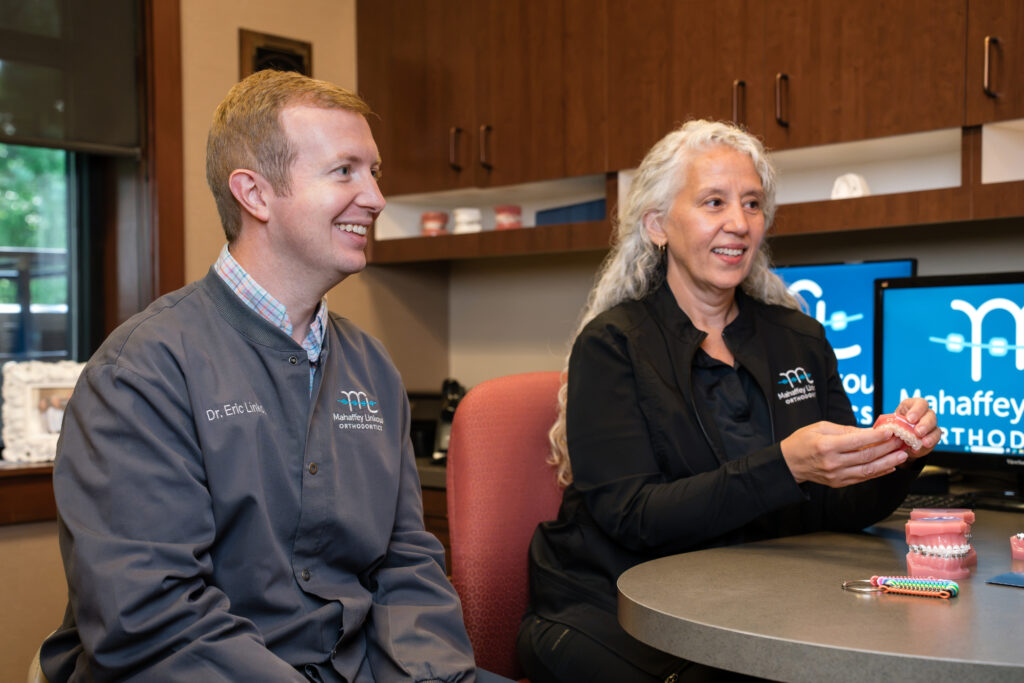
At Mahaffey Linkous Orthodontics, Dr. Mahaffey and Dr. Linkous are orthodontic specialists who treat every age group under one roof. That matters when you have a 9-year-old needing early evaluation, a teen ready for clear aligners, and a parent considering clear braces, all in the same household.
How to Evaluate an Orthodontist: The 6 Questions to Ask
Bring this list to your first free consult. Good orthodontists welcome every one of these questions.
1. Are you a trained orthodontic specialist and AAO member?
Ask directly: “Did you complete an accredited orthodontic residency, and are you a member of the American Association of Orthodontists?” AAO membership is only available to specialists who completed an accredited residency program, so it’s a quick trust signal.
2. What happens after my braces or aligners come off?
Treatment doesn’t end the day your braces come off or you finish your last aligner. Ask how the practice handles retention: what type of retainer you’ll get, how long you’ll need to wear it, and how follow-up visits work once active treatment is done. A good orthodontist builds a retention plan into your care from the very first visit, because that’s what keeps your results in place for life. Our team walks every family through retainer care so the smile you worked for stays right where it belongs.
3. What treatment options do you offer for my family’s needs?
A specialist should offer a full menu: traditional metal braces, clear braces, and clear aligners for different ages and lifestyles. If a practice only pushes one product, you’re not getting a plan built around you.
4. What will my personalized treatment plan and timeline look like?
Ask to see what your plan looks like step by step. How long will treatment take? How often will you visit? What happens if something breaks? Clear answers up front mean fewer surprises later.
5. What technology do you use for diagnostics and treatment?
Modern tools make a real difference in comfort and accuracy. We use digital scans instead of goopy impressions, and as a top 1% of Invisalign providers, we rely on the latest clear aligner planning software.
6. How will I be treated as a patient and a person?
This one is harder to measure but easy to feel. Does the team greet you by name? Do they listen? You’re more than a smile, you’re family, and the right practice will show you that from day one.

Benefits of Choosing a Dedicated Orthodontic Specialist
A dedicated specialist does one thing all day, every day. That focus translates into better diagnoses, better plans, and better smiles. Here’s what you gain when you choose an orthodontist over a general provider for your family’s care.
- Catches what general dentists may miss. Specialists are trained to spot complex bite issues, jaw development concerns, airway problems, and crowding patterns that affect long-term oral health, not just appearance.
- Wider range of transformative options. Because Mahaffey Linkous Orthodontics offers metal braces, clear braces, and clear aligners, your plan is built around your goals and lifestyle, not around what the office happens to stock.
- More precise, predictable results. Daily focus on tooth movement means your orthodontist sees hundreds of similar cases a year, which sharpens judgment on timing, mechanics, and finishing details.
- Expert growth guidance for kids. The AAO recommends a first orthodontic evaluation by age 7 because specialists are trained to guide facial and jaw growth during critical windows, sometimes avoiding more involved treatment later.
- One practice for every life stage. With orthodontics for all ages at our Peachtree City Office, your 8-year-old, your teenager, and you can all be seen by the same trusted team. That means shared records, coordinated scheduling, and a family rhythm that’s easy to maintain.
- Advanced technology that improves comfort. Digital scanners replace messy impressions, treatment planning software gives you a preview of your dream smile, and modern bracket systems are smaller and smoother than those of a decade ago.
- Clear, honest communication. Specialists are trained to explain the “why” behind every recommendation, so you understand what’s happening in your mouth and feel confident in the plan.
The bottom line? When your family invests years into a smile, you want the person doing it to specialize in exactly that.
Orthodontist vs. General Dentist: What’s the Difference?
Both are important members of your oral health team, but they aren’t interchangeable. Your general dentist handles cleanings, cavities, and overall dental health. An orthodontist is a specialist in moving teeth and guiding jaw development. For anything more than the mildest alignment concern, a specialist delivers better outcomes.
| Factor | Orthodontist | General Dentist |
|---|---|---|
| Education | Dental school + 2-3 year orthodontic residency | Dental school only |
| Daily focus | 100% orthodontic cases | Cleanings, fillings, crowns, mixed services |
| Case complexity | Handles complex bites, airway, growth guidance, surgical cases | Typically mild alignment only |
| Treatment range | Metal braces, clear braces, clear aligners, two-phase treatment | Often limited to one aligner brand |
| Credentials | AAO member, accredited orthodontic residency | DDS or DMD, no specialty residency |
| Best for | Kids, teens, adults with any orthodontic need | Routine dental health and preventive care |
Think of it this way: your family doctor is wonderful, but when you need heart surgery, you see a cardiologist. The same logic applies to your smile.
Who Should See an Orthodontist? Signs It’s Time for a Consultation
The American Association of Orthodontists recommends every child receive a first orthodontic evaluation by age 7. Teens are the most common age group for full treatment, and adults can start care at any age with excellent results.
Watch for these signs in any family member:
- Crowded, overlapping, or crooked teeth
- Noticeable gaps between teeth
- Overbite, underbite, or crossbite
- Jaw discomfort, popping, or clicking
- Difficulty chewing or biting
- Mouth breathing or snoring
- Speech issues related to tooth position
- Teeth that don’t meet properly when the mouth is closed
- Thumb-sucking that has continued past age 5
One of the quiet advantages of a family orthodontist is efficiency. You can schedule a parent’s clear aligner check and a child’s growth evaluation back to back, saving time and simplifying your week.
Frequently Asked Questions About Choosing an Orthodontist
How do I pick the right orthodontist for my family?
Start by confirming the provider is a true orthodontic specialist with AAO membership. Then weigh treatment options, technology, and how the team makes you feel during your first visit. A free consult is the easiest way to compare practices without pressure.
Do I need a dentist referral to see an orthodontist?
No, you do not need a referral to schedule a free consult with an orthodontist. You can book directly, and most practices, including ours, welcome self-referrals. Your general dentist and orthodontist can coordinate care once treatment begins.
Should I get a second opinion from another orthodontist?
Yes, especially for longer or more involved cases. A second opinion is easy to get when the first visit is free, and it builds confidence in whichever plan you choose. Different specialists may offer different approaches, and comparing them helps you make the most informed decision.
Are virtual consultations a good first step?
Virtual consultations are an excellent low-pressure way to start. You can share a few photos and get initial feedback on candidacy, likely treatment options, and next steps before coming in. We offer virtual consult options at Mahaffey Linkous Orthodontics so busy families can begin from home.
Ready to see if we’re the right fit? Schedule your free consult at our Peachtree City Office, 268 S Peachtree Pkwy., Peachtree City, GA, or call (770) 487-6439. Stop dreaming, start smiling.